


Garden · All year
Nick Peters · · 4 min read
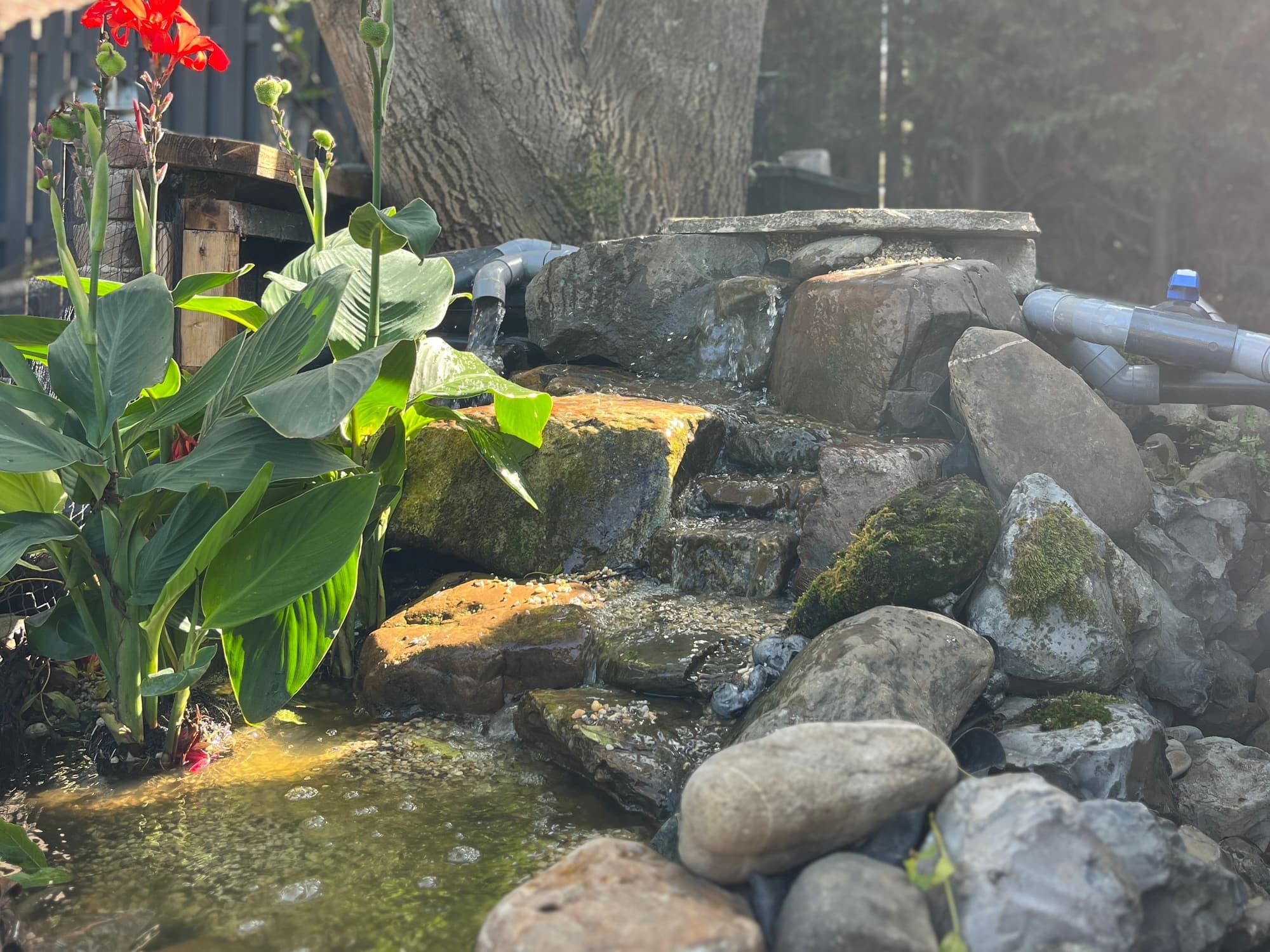 Own work · Pond renovation
The word permaculture sounds big. As if you first need a vegetable patch, chickens and a water butt before you're allowed to join in. It's not that bad. At its core, permaculture is a way of looking and designing, and it works in an ordinary back garden in Stein or Geleen too.
Where it comes from
The word is a contraction of permanent agriculture and permanent culture. Two Australian biologists, Bill Mollison and David Holmgren, came up with it in the 1970s. They looked at how a forest sustains itself and turned that into a method for designing such systems yourself. Underneath lie three principles: care for the earth, care for people, and share what is left over.
What I like about it: it isn't a style. A permaculture garden doesn't look one particular way. Every place has different soil, different light and different water, and the design follows the place.
Start by watching for a season
Holmgren's first principle is to observe. That sounds obvious, but most gardens are made the other way round: first a plan, then a place to fit it. Walk through your garden with different eyes for a whole season. Where is the sun at ten o'clock, and where at four? Where does water stand after a heavy shower, and where is it always the first to dry? Which direction does the wind come from?
Look under your feet as well. Brussels Environment gives a simple test: dig out a clod thirty by thirty centimetres and fifteen deep, and count the earthworms. More than ten means rich soil. If you find one, there is too little organic matter in it. That count tells you more about your garden than any plant book.
I do the same with a garden design. I first look at the soil, the water and the light, and at how you use the garden. Only then do I draw.
Put things where you need them
Permaculture divides a site into zones. Zone zero is the house. Zone one is what you use every day: herbs, some cut-and-come-again lettuce. The further from the house, the less attention something needs, all the way to zone five, which you leave wild. An ordinary garden only has a few zones, but the idea still works. A herb planter at the back of the garden is one you won't use. And a corner you never visit doesn't need keeping up either: it can go wild.
Let every part do more than one thing
This is the principle I see most often in gardens. Mollison himself used the pond as an example: it catches and stores water, plants grow in it and animals live in it, it stores heat and reflects light. So a pond is never just a pretty picture.
The same goes for the edge around it. Permaculture calls this the edge effect: where two environments meet, such as water and land, life is extra rich. A pond with a gentle, planted bank holds more life than a basin with steep sides, and gives animals that come to drink a safe place.
Close the loop in your own garden
Another principle: what the garden makes, stays in the garden. Plant remains become food again. For me that comes down to things I do at every autumn service. The leaves can stay in the border, because they protect the soil from frost and are food and shelter for whatever lives in your garden. The sludge I take out of a pond goes into the border, not into a skip. You don't have to buy anything for it; you just mustn't throw it away.
Small and slow
Holmgren recommends small, slow solutions. That's good news if you don't want to, or can't, do everything at once. You don't have to overhaul your garden in one go. Start with one spot: a patch of lawn that becomes a border, a paved path that could be narrower, a water butt by the shed. See what happens, then take the next step.
What it isn't
Permaculture is no guarantee of a garden without work, and it isn't a creed either. It's a toolbox: you take from it what suits your place and your life. If you want to go deeper, Permacultuur Nederland offers a free course, and David Holmgren's site has the twelve principles themselves.
Want to know what this means for your garden? Send me a few photos and I'll take a look. An introduction is free of obligation.
Sources
- Permacultuur Nederland, Permacultuur, ontwerpen met de natuurorigins, ethics, free course
- Leefmilieu Brussel (Brussels Environment), Mijn tuin in permacultuur (2018)Mollison's principles with the pond example, edge effect, zoning, worm count
- David Holmgren, Permaculture Principlesobserving; small and slow solutions