


Garden · Autumn · Winter
Nick Peters · · 4 min read
 Mood image
Food forests are popular. You read about them in the paper, councils plant them, and more and more often someone asks whether one would fit in their back garden. The honest answer: a food forest won't, but almost everything that makes a food forest good will.
What a food forest is
In November 2017, some twenty parties signed the Green Deal Voedselbossen (Food Forests) in Lelystad, among them three ministries and the Province of Limburg. It sets out what a food forest is: a productive ecosystem designed by people on the model of a natural forest, with many perennial and woody species that have edible parts. It has a canopy of tall trees, at least three other layers beneath it, rich soil life, and it is at least half a hectare in size.
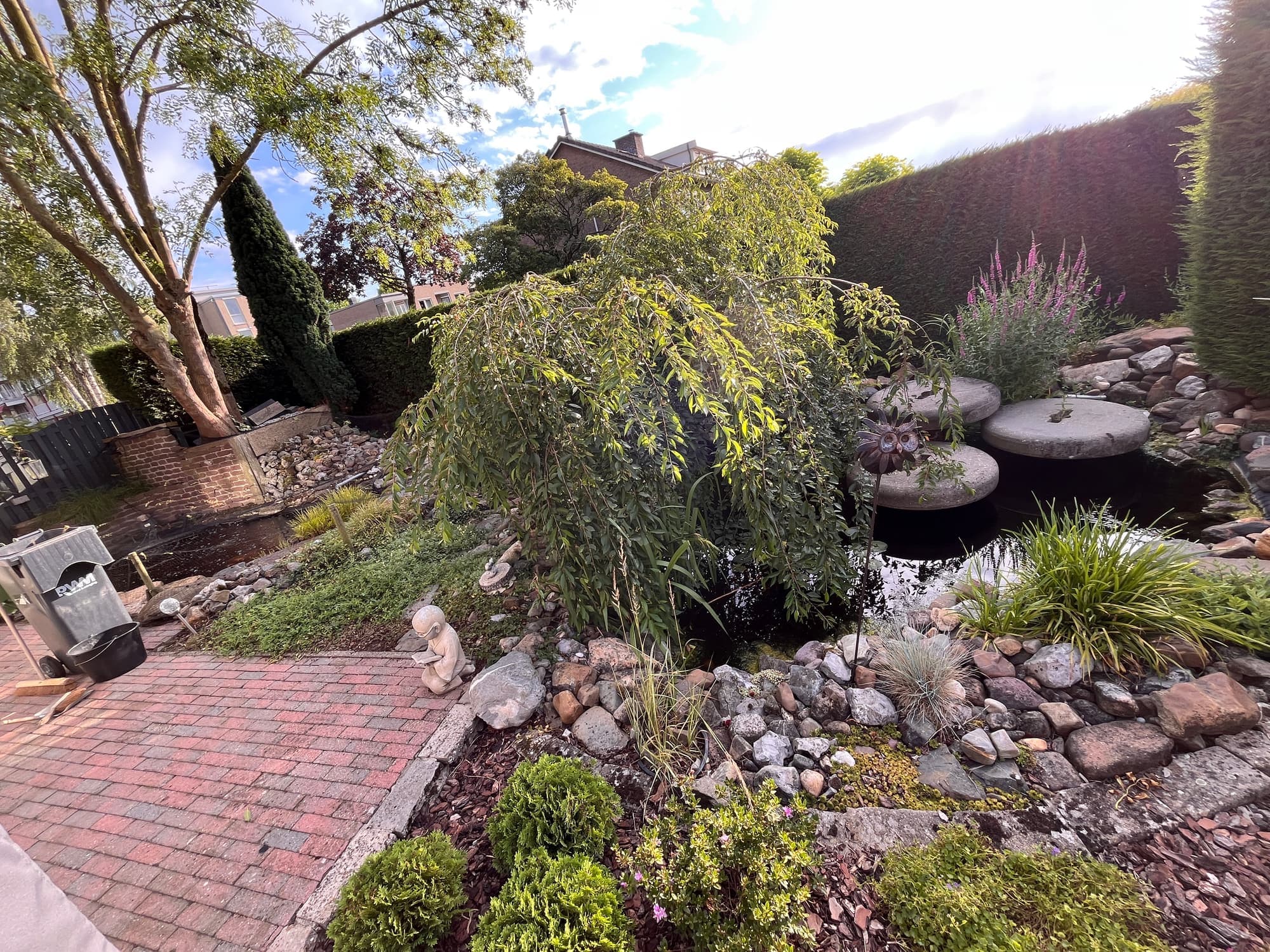
That last requirement is why a back garden is officially not a food forest. Wouter van Eck, who started the oldest food forest in the Netherlands, says himself that the term is suffering from inflation: a little copse without a single real tree in it is not a food forest. So in a garden I'd rather call it something else: a layered garden, or an edible edge.
What you can learn from it
Van Eck started in 2009 near Groesbeek, on an exhausted maize field of about 2.4 hectares. Voedselbos Ketelbroek now has hundreds of edible species. A few things from his experience are useful in a garden too.
Plant in layers. A forest has tall trees, lower trees, shrubs, herbs, ground cover, climbers and a layer below ground. In a garden you can copy that on a small scale: one tree, shrubs beneath it, perennials and a ground cover. Examples from the sources: walnut as the tall tree, sea buckthorn as the shrub, strawberry as ground cover, grape or kiwi as the climber. A walnut does grow large, though; in a small garden a lower fruit tree is the canopy.
Put every plant where it naturally belongs. Strawberry grows naturally on shady forest floors, which is why it works as ground cover in a food forest. A sunny spot is for sun lovers such as sea buckthorn and apricot, a shady one for wild garlic and hosta.
Know your soil and your water. Van Eck looks first at the highest groundwater level. Trees with a taproot, such as sweet chestnut, walnut and persimmon, don't want their roots in water. The soil type and the wind also decide what will work.
Think of insects. "An insect hotel is fine, but an insect restaurant is far more important," says Van Eck. Early in the year there is little to eat; cornelian cherry, honeyberry and almond flower early.
What it yields
The measurements are encouraging. In the Haarzuilens food forest, researchers from Naturalis and Leiden University counted 18,572 insects, against 3,379 in the herb-rich grassland next to it: 5.5 times as many. In six years the number of breeding bird species there doubled. In Ketelbroek, according to Van Eck, the organic matter content of the soil rose in ten years from 2 to 7–9 percent, because the leaves of all the layers above feed the soil.
At the same time, Wageningen University & Research says that little scientific research on food forests has been done so far, and that it takes about ten years before a food forest produces at its best. Whoever starts one, starts for the long term.
Patience, and a bit of mess
A layered garden looks different from a lawn with a neat flowerbed. Especially in winter it looks untidy. That's part of it: leaves that stay put become food. Van Eck puts it briefly: the hoe and the leaf blower don't belong there. Doing nothing at all isn't it either; rampant brambles need pulling out now and then.
Planting is best done at the start of winter, when you don't need to water. If a dry summer follows, give a good soaking every few weeks rather than a little every time.
How I help with that
Planting in layers, from ground cover to tree, is one of the things I do. I look at what is already there, at the soil and the light, and choose plants that suit the place and give food and shelter to bees, birds and other life. If you want to pick species yourself, Stichting Voedselbosbouw Nederland has a database you can search by soil and light.
Send me a few photos of your garden and I'll see what's possible.
Sources
- Stichting Voedselbosbouw Nederland, Wat is een voedselbos?definition, layers, 0.5 hectare
- Green Deal Voedselbossen (C-219), full textarticle 2; Province of Limburg as a party
- IPLO, factsheet, VoedselbossenKetelbroek 2009, November 2017 Lelystad, some 20 parties, strawberry as ground cover, organic matter 2 % to 7–9 %
- De Levende Natuur, Voedselbossen van belang voor biodiversiteit (2017)2.4 hectare maize field
- Stad + Groen 1/2025, interview with Wouter van Eckinflation of the term, insect restaurant, early flowerers, groundwater and taprooted trees, sun and shade, planting time and watering, hoe and leaf blower
- Voedselbosbouw Nederland, 5,5 keer meer insecten (2025)
- WUR, Voedselbossen zijn hip (2021)little research, ten years to full production
- Voedselbosbouw Nederland, databank voedselbossoorten