


Garden · Autumn · Winter
Nick Peters · · 4 min read
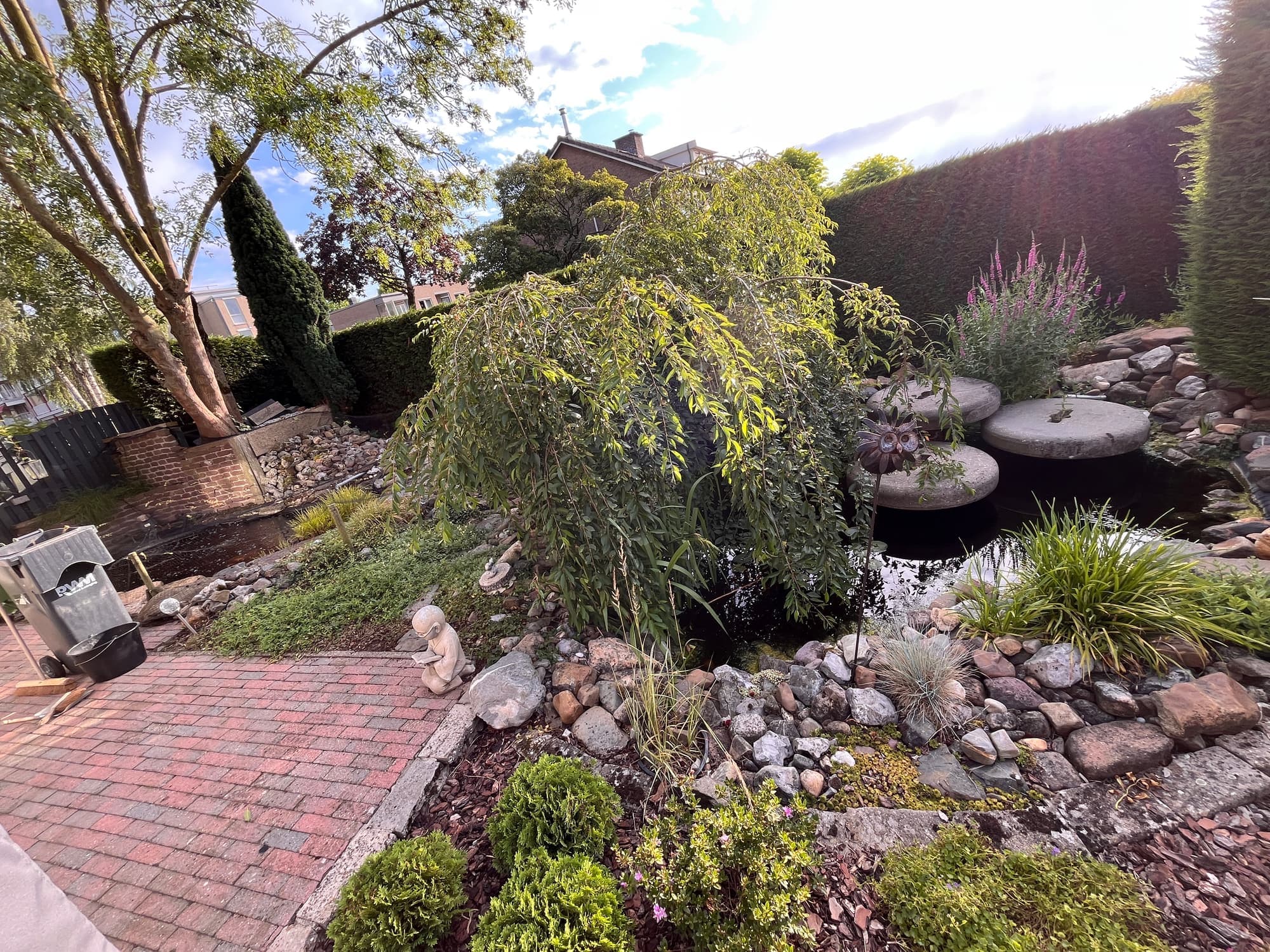 Own work · Pond renovation
Regenerative is a word from farming. It means you don't just maintain the soil, you make it better. Farmers do it because otherwise their land can't keep going. It works the same way in a garden, and it saves you work as well.
The Flemish knowledge organisation B3W sums it up in five principles. I'll go through them, translated to the garden.
1. Disturb the soil as little as possible
The English Royal Horticultural Society is clear about it: digging damages the soil. You destroy the tunnels worms have made, you break fungal networks, and carbon that was in the ground is released. If you don't dig, that structure stays intact.
This is how you make a new bed. Lay a double layer of cardboard on the grass or weeds (no glossy printed cardboard, and take off staples and tape) and shovel ten to fifteen centimetres of well-rotted organic matter, such as compost, on top. According to the RHS, the end of winter is the best time, as long as the ground isn't sodden. Make beds about 1.2 metres wide, so you can reach them from both sides without standing on them. A shrub or tree you simply plant in a planting hole; the point is that you don't dig over the whole bed.
2. Keep the ground covered
Bare ground dries out, and sunlight harms soil life. Covered soil stays cool, moist and alive, and weeds get less of a chance. In a garden that means: about five centimetres of mulch every year, usually in autumn, and as few bare patches between the plants as possible.
You already have the easiest mulch. Leave the leaves in the border: they protect the soil from frost and are food and shelter for whatever lives in your garden. Only from the pond do they have to come out. And the sludge I take out of a pond at an autumn service goes into the border.
3. Make sure there is variety
The more different plants, above and below ground, the stronger the whole. Different roots feed different soil life, and diseases and pests get less of a hold. A border with five species is more resilient than a strip with one.
4. Leave roots in the ground
Living roots are the soil's fuel. Through their roots, plants release sugars to the soil life, and that soil life in turn frees up nutrients for the plant. Soil without roots soon grows poor. Perennials, shrubs and ground cover keep roots in the ground all year; a bed left bare all winter doesn't.
5. Let life in
For farmers, the fifth principle is about livestock on the land. In a garden you don't need to keep animals. There it comes down to leaving room for what turns up by itself: worms, beetles, birds. Leaves that stay put and a corner that isn't tidied every week already help.
Why it counts extra here
In the Netherlands, loess is found only in South Limburg. It is a fertile soil that holds water well, but without plant cover it washes away, especially on a slope, and it compacts easily. Waterschap Limburg, the regional water authority, warns that rainwater running off South Limburg's slopes can cause erosion and mudflows. On arable fields, according to the water authority, not ploughing combined with cover crops gives 40 to 60 percent less run-off and erosion. That was measured on farmland, not in gardens, but the principle is the same: covered ground with roots in it holds on to water and soil.
Paving does the opposite. For gardens larger than 15 square metres, Steenbreek advises keeping 80 percent green and at most 20 percent paving, so rainwater can soak into the ground and the sewer has less to deal with.
Start small
You don't have to do everything at once. Stop digging, leave the leaves in the border this autumn, and next spring count the worms in a clod thirty by thirty centimetres and fifteen deep. More than ten means rich soil.
Want help with a new border, or with your pond before winter? Send me a few photos and I'll take a look.
Sources
- B3W, Regeneratieve landbouw in de praktijk (January 2024)the five principles, cover, living roots
- RHS, No-dig gardeningdamage from digging, cardboard and 10 to 15 cm, end of winter, 1.2 m, 5 cm of mulch a year
- Stal en Akker, Löss, grondsoort van het jaar 2021loess only in South Limburg, erosion, compaction
- Waterschap Limburg, Erosie en niet-kerende grondbewerking40 to 60 % less run-off
- Steenbreek80 % green, 20 % paving
- Leefmilieu Brussel (Brussels Environment), Mijn tuin in permacultuur (2018)worm count